📞  — free, 24/7
— free, 24/7 — free, 24/7| Dosage | Package | Price per Dose | Price | |
|---|---|---|---|---|
| 50mg | 360 pills | NZ$2.02 | NZ$969.41 NZ$727.06 Best Price | |
| 50mg | 180 pills | NZ$2.16 | NZ$519.54 NZ$389.65 | |
| 50mg | 120 pills | NZ$2.45 | NZ$392.81 NZ$294.61 | |
| 50mg | 90 pills | NZ$2.78 | NZ$332.62 NZ$249.46 | |
| 50mg | 60 pills | NZ$3.09 | NZ$247.08 NZ$185.31 | |
| 50mg | 30 pills | NZ$3.26 | NZ$129.86 NZ$97.40 | |
| 100mg | 360 pills | NZ$3.52 | NZ$1,688.57 NZ$1,266.42 Popular | |
| 100mg | 180 pills | NZ$3.56 | NZ$855.36 NZ$641.52 | |
| 100mg | 120 pills | NZ$3.64 | NZ$582.90 NZ$437.17 | |
| 100mg | 90 pills | NZ$3.75 | NZ$449.84 NZ$337.38 | |
| 100mg | 60 pills | NZ$3.85 | NZ$307.27 NZ$230.46 | |
| 100mg | 30 pills | NZ$4.35 | NZ$174.21 NZ$130.66 |
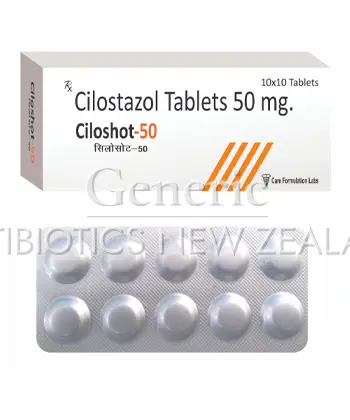
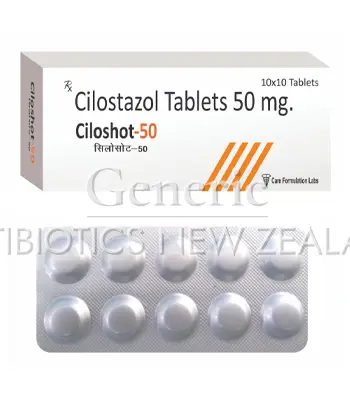
Cilostazol is a selective phosphodiesterase-3 (PDE3) inhibitor with antiplatelet and vasodilatory properties. It increases cyclic adenosine monophosphate (cAMP) in platelets and vascular smooth muscle, reducing platelet aggregation and improving perfusion in peripheral arterial disease.
Clinically, cilostazol is used to treat intermittent claudication due to peripheral arterial disease. It is administered orally, typically at 100 mg twice daily after meals, with dose reductions for renal or hepatic impairment as indicated by guidelines and labeling.
As a PDE3 inhibitor, cilostazol modulates intracellular cAMP to promote vasodilation and decrease platelet activation. These dual actions support improved walking distance and reduced claudication symptoms in selected patients. The drug is once-daily in practice, though standard regimens rely on twice-daily dosing after meals for stable plasma levels.
Pharmacokinetics show rapid absorption with a half-life that supports twice-daily dosing; metabolism occurs primarily via CYP3A4 and CYP2C19 pathways. Steady-state levels are reached within days. Renal or hepatic impairment alters exposure, necessitating monitoring and dose adjustments. Concomitant potent CYP3A4 or CYP2C19 inhibitors or inducers may change cilostazol exposure and safety.
Cilostazol is a selective PDE3 inhibitor with a strong antiplatelet effect combined with vasodilatory action. In contrast, milrinone and inamrinone are PDE3 inhibitors used principally in acute heart failure and are administered intravenously, not for claudication. Dipyridamole acts as a nonselective PDE inhibitor with antiplatelet effects, often used in combination with other therapies for stroke prevention or valve prophylaxis, but its vascular and antiplatelet profile differs from cilostazol.
Pentoxifylline is a methylxanthine derivative that inhibits several phosphodiesterases nonselectively and improves microcirculation, but its efficacy for intermittent claudication is less robust than cilostazol. Overall, cilostazol is the preferred agent for symptomatic peripheral arterial disease when antiplatelet and vasodilatory effects are desired in an oral therapy plan.
The primary indication is intermittent claudication due to peripheral arterial disease. Cilostazol improves walking distance and pain-free ambulation in appropriately selected patients. It is commonly used alongside supervised exercise programs and risk modification, such as smoking cessation and lipid control.
Therapy is generally considered for patients without heart failure and without significant bleeding risks. It may be avoided in pregnancy where data are limited and in patients with unstable cardiovascular status. Monitoring focuses on symptom response, blood pressure, heart rate, and potential adverse effects.
The following table summarizes key distinctions among cilostazol and two related alternatives.
| Agent | Primary mechanism | Major indications | Important cautions |
|---|---|---|---|
| Cilostazol | Selective PDE3 inhibition; increases cAMP; vasodilation + antiplatelet | Intermittent claudication in PAD; improved walking distance | Contraindicated in heart failure; monitor for hypotension, tachycardia; interactions with strong CYP inhibitors/inducers |
| Dipyridamole | Nonselective PDE inhibition; antiplatelet effects via cAMP elevation | Stroke prevention adjunct; valve prophylaxis; some vasodilator use | Less robust efficacy in claudication; potential interactions with anticoagulants; headaches common |
| Pentoxifylline | Nonselective PDE inhibition; rheologic effects on blood viscosity | Peripheral vascular insufficiency with intermittent claudication (less preferred) | Variable efficacy; gastrointestinal effects; caution in bleeding risk |
Where applicable, therapy should be tailored to patient comorbidity, concomitant medications, and risk of adverse events, recognizing cilostazol’s unique combination of antiplatelet and vasodilatory actions among PDE inhibitors.
The most common adverse effects are headaches, dizziness, palpitations, and mild GI upset; edema and flushing may occur, particularly with concomitant vasodilators or fluid shifts. Bleeding risk can be enhanced when combined with other antiplatelet or anticoagulant therapies. Vision or scleral changes are uncommon but require reporting if noted.
Contraindications include a history of congestive heart failure with reduced ejection fraction. Caution is advised in hepatic or renal impairment, and in patients on strong inhibitors or inducers of CYP3A4 or CYP2C19. Pregnant patients should be managed on a case-by-case basis, with data limited on fetal effects. Regular monitoring for blood pressure, heart rate, and signs of intolerance is advised.
14–21 days. Free from NZ$342.37 .
5–9 days. NZ$51.36
−10% when paying with cryptocurrency.
−10% on all repeat orders.
All orders are packed in neutral, unbranded boxes with no product name on the outside.